Burial plots near New York's Muslim communities are running out. Here's what that means for your family, and what you can do about it now.

There’s a conversation most Muslim families in New York keep putting off. Not because they don’t care, but because it feels too heavy, too far away, or just not urgent yet. The problem is that in this region, waiting has real consequences. Burial plots in dedicated Muslim sections are disappearing. Prices have climbed sharply since the pandemic. And when a death happens, Islamic tradition calls for burial as soon as possible, leaving grieving families with almost no time to figure things out from scratch.
This post is for families who want to be prepared, not scrambling. And it starts with understanding what is happening on the ground here in New York.
Here’s the situation, plainly stated: New York City has no dedicated Muslim-only cemeteries. Not one. For families in Queens, Brooklyn, the Bronx, and Manhattan, that means the nearest Muslim burial ground is on Long Island, and the drive alone from Brooklyn takes roughly an hour and a half.
Washington Memorial Park in Mt. Sinai has long been the primary option for Muslim burials in this region. But community leaders have publicly called the situation “dire,” with available plots running critically low. The Muslim Alliance of Long Island has spent years trying to establish a new Muslim cemetery on Long Island, without success.
New York State’s zoning laws make building new cemeteries nearly impossible, and local opposition has blocked every serious proposal. This is not a distant, theoretical problem. It is the reality facing every Muslim family in this metro area right now.

The short answer is that demand has grown far faster than supply, and supply has almost no room to expand. There are over 750,000 Muslims living in New York City alone, making it the largest Muslim urban population in the United States. The greater metro area is home to approximately 1.5 million Muslims. And yet the infrastructure to serve that community at the time of death has not kept pace.
Part of this is regulatory. New York State has some of the most restrictive cemetery zoning laws in the country, shaped by legislation that dates back nearly a century. Even when a Muslim organization identifies land and has the funding, the process of converting it into a licensed cemetery is a years-long battle, and towns routinely push back. That resistance has killed proposal after proposal across Long Island.
Part of it is economic. After COVID-19, the cost of cemetery plots in the New York area spiked sharply, and prices have not come back down. Mosques that once had access to group pricing for congregation members have largely lost that option as cemeteries respond to increased demand with market-rate pricing.
And part of it is simply the math. There are fewer than 20 funeral homes in New York City that serve the Muslim community, down from 50 not long ago. The combination of limited cemetery access, rising costs, and fewer service providers has created a bottleneck that families run directly into at the worst possible moment: the hours after a loved one passes.
If you are Muslim and you live in Queens, Brooklyn, the Bronx, or Manhattan, this is your reality. The families who are in the best position are the ones who did not wait.
There is a concept in Islamic theology called Sadaqa Jariyah, a righteous deed whose benefit continues after you are gone. Most people associate it with building a masjid or funding a water well. But scholars and community leaders have long framed pre-need burial planning in exactly these terms.
When you secure a burial plot and arrange your affairs in advance, you are removing a burden from your family, protecting them financially, and ensuring that your final rites are handled according to Islamic law, without compromise and without chaos.
Islamic law is clear that burial should happen as soon as possible after death. That urgency is not just a guideline, it shapes everything. The moment a Muslim passes, the clock starts. Ghusl must be arranged. The kafan must be prepared. A janazah prayer must be coordinated with an imam. A burial permit must be obtained from the town. And a plot must be available at a cemetery that follows the proper orientation toward the Qibla.
If any one of those pieces is missing, the family is left scrambling during the most painful hours of their lives. Pre-need planning does not mean dwelling on death. It means honoring the Islamic understanding of what death is: a transition, not an ending.
Families who plan ahead are not being morbid. They are being responsible in the deepest sense, spiritually, practically, and financially. They are giving their children and spouses a gift that cannot be bought in the moment of grief: a clear path forward, already arranged, already paid for, and already aligned with their faith.
Want live answers?
Connect with a Akhirah expert for fast, friendly support.
Pre-need planning is simpler than most families expect, and far less emotionally taxing than making the same decisions under pressure. At its core, it means working with an Islamic burial provider before the need arises to secure a plot, document your burial preferences, and establish a clear plan that your family can follow without having to figure anything out in real time.
It is not a single transaction. It is a relationship. And in a region where burial plots are genuinely scarce and the logistics of Islamic burial are genuinely complex, that relationship is one of the most valuable things a Muslim family in New York can have.
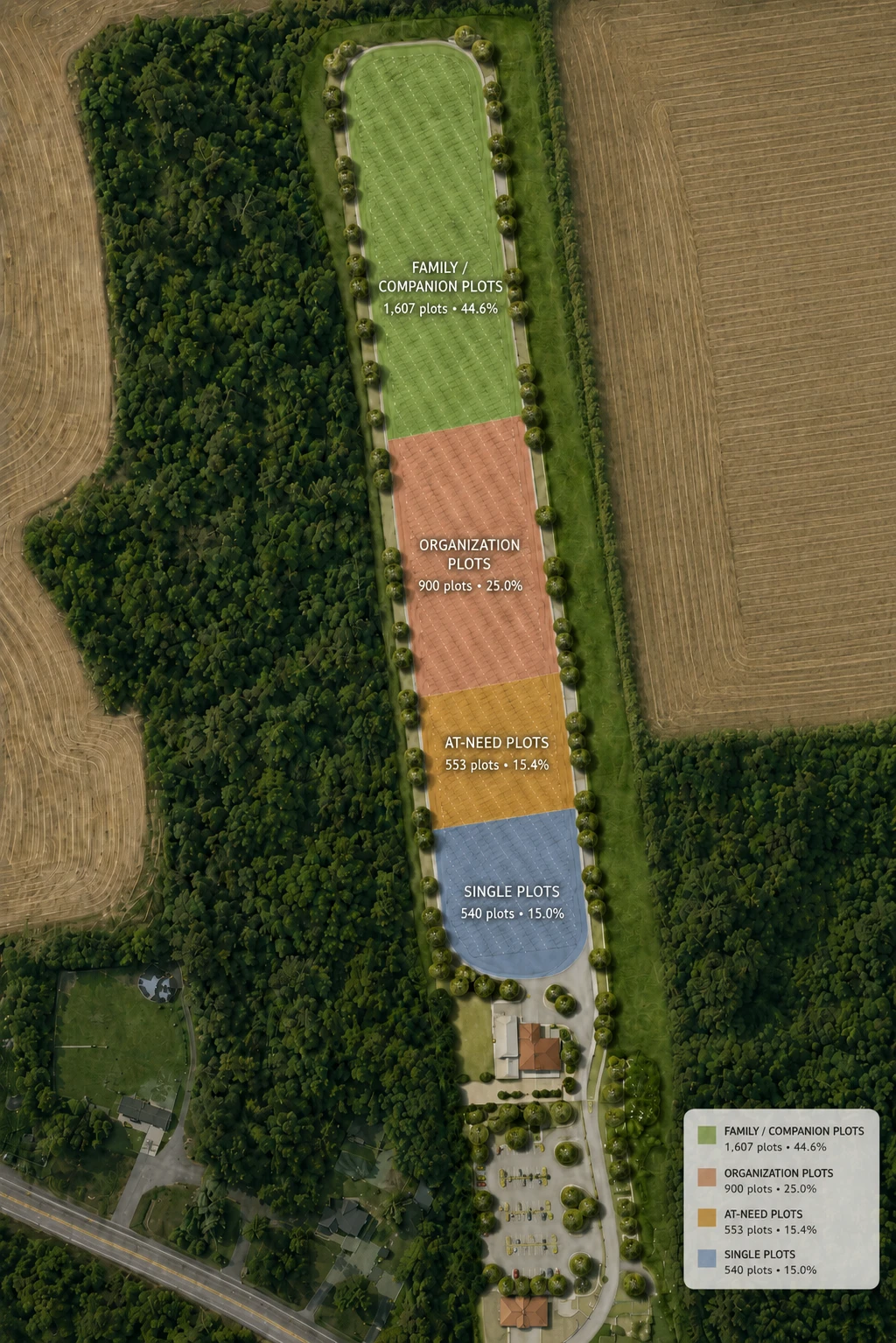
The process begins with a conversation, one that covers your wishes, your family’s circumstances, and the practical realities of burial in your area. For families in Queens or Brooklyn, that conversation needs to account for the distance to Long Island burial sites and what it means logistically when time is short. For families already on Long Island, it means understanding which sections are still available and what documentation will be needed when the time comes.
From there, a burial plot is secured in a dedicated Muslim section of a cemetery that meets Islamic requirements: proper Qibla orientation, no embalming, and no pressure toward practices that conflict with Islamic law. That plot is yours. It is documented. Your family does not have to search for one, call around, or compete with other families for a spot when they are already in grief.
Pre-need planning also means your ghusl preferences are documented, including who you want performing the ritual washing and any specific requests related to your cultural or ethnic background. The Muslim community across Long Island, Queens, Brooklyn, the Bronx, and Manhattan is not monolithic. South Asian families, Arab families, West African families, and others each bring specific traditions and preferences to the burial process. A good pre-need plan captures those details so nothing is left to interpretation.
The paperwork side is also addressed in advance. New York’s burial permit system requires coordination with multiple agencies, a process that is genuinely complex when you are not familiar with it and genuinely stressful when you are doing it while grieving. Pre-planning families have already navigated the key steps, which means the hours after a death are spent with family, not on hold with a government office.
Locking in your arrangements now also provides financial protection. Prices have risen significantly and continue to rise. Families who secure their plots today are not subject to whatever the market looks like in five or ten years. That is not a small thing in a region where burial costs have already climbed sharply since the pandemic.
One of the most common questions we hear is: “Am I too young to be thinking about this?” The honest answer is no, and Islamic tradition would say the same. Death has no age requirement, and the families who have been most grateful for pre-planning are often those who did it in their 40s or even earlier, prompted by a parent’s illness or a community member’s passing. The urgency of Islamic burial means that being unprepared at any age puts your family in a difficult position.
Another question that comes up often: “What if I move? Do I lose what I’ve paid for?” This is a legitimate concern, and it’s one worth discussing directly with any provider before committing. The key is to understand the terms of your arrangement clearly and in writing: what is transferable, what is refundable, and what happens if your circumstances change.
Families in Brooklyn and Queens frequently ask if they really need to plan for a Long Island burial, or if there are options closer to home. Right now, the reality is that there are no Muslim cemeteries within the five boroughs. The drive from Brooklyn to the nearest Muslim section on Long Island via the I-278 and I-495 is roughly an hour and a half under normal conditions. In a time-sensitive situation, that distance matters. Pre-planning does not eliminate the distance, but it eliminates the uncertainty; your family knows exactly where they are going and what they will find when they get there.
Some families also ask about the risk of doing nothing. In New York City, when a person dies without burial arrangements and without family able to coordinate quickly, the city does have a process for handling unclaimed remains, and it does not involve a Muslim cemetery or Islamic rites. Pre-planning is the only reliable way to ensure that outcome never becomes possible for your family.
The Muslim community across Long Island, Queens, Brooklyn, the Bronx, and Manhattan deserves burial options that reflect their faith, and families who plan ahead are the ones who actually secure those options before they disappear. Plots are limited. Prices are rising. And the Islamic obligation to bury quickly means there is no margin for uncertainty when the time comes.
Pre-need planning is not about fear. It is about love, faith, and giving your family the clarity they will need when they are least equipped to figure things out on their own. It is Sadaqa Jariyah in one of its most personal forms.
No matter if you are ready to have this conversation, or even just ready to ask a few questions, reach out to us at Akhirah House of Worship. We are here to walk through this with you, at whatever pace feels right.
Summary: