Most Islamic burials rely on a compass reading at the graveside. Here's why that's not the same as a cemetery designed around the Qibla from the ground up.
If you’re researching Islamic burials in New York, no matter if it is for a loved one you’ve just lost or because you want to plan ahead, you’ve probably seen the phrase “facing the Qibla” come up more than once. Most families know the deceased should face Mecca. What most families don’t know is how rarely that requirement is truly guaranteed, and how much depends on whoever shows up with a compass on the day of burial.
“Qibla-oriented by design” means something different. It means the orientation is built into the grounds themselves: not calculated under grief, not approximated, and not dependent on a single person getting it right in a difficult moment. Here’s what that looks like, why it matters, and what it means for Muslim families across Queens, Brooklyn, the Bronx, Manhattan, and Long Island.
The Qibla is the direction of the Kaaba in Mecca, the same direction Muslims face during Salah. In Islamic burial, the deceased must be placed in the grave on their right side with their face turned toward the Qibla. This is not a regional custom or a cultural preference. There is unanimous scholarly consensus across all four major schools of Islamic jurisprudence (Hanafi, Maliki, Shafi’i, and Hanbali) that this is a required element of proper Islamic burial. The Dar al-Ifta of Egypt has confirmed it explicitly: “There is a consensus among the imams of the four schools of jurisprudence on this manner of burial.”
The direction of the Qibla from New York is northeast, not due east, as many people assume. That distinction alone matters. Once the grave is closed, Islamic law holds that it should not be reopened to correct an error. Whatever happens at the time of burial is, in most cases, permanent.
Here’s the reality that most families in Queens, Brooklyn, the Bronx, Manhattan, and Long Island don’t realize until they’re already in the middle of it. The majority of Islamic burials in this area take place in non-Islamic cemeteries, meaning cemeteries whose layouts, grave rows, and plot orientations were never designed with the Qibla in mind. When a burial happens at one of these sites, someone typically uses a compass or a phone app at the graveside to determine the Qibla direction and attempts to position the body accordingly within whatever plot space is available.
That process is better than nothing. But it introduces variables that a grieving family has no way to control or verify. The terrain may slope. The available plot may not allow for the correct positioning. The funeral director may be experienced in Islamic practice or may be doing their best without deep training. Time pressure is real; Islamic law calls for burial as soon as possible after death, ideally within 24 hours, which means decisions are made quickly and under emotional weight. Once the burial is complete, there is no going back.
There’s also a subtler issue. The preferred grave type in the Sunnah is the Lahd, which is a niche dug into the Qibla-facing side wall of the grave, into which the body is placed facing Mecca. Executing a Lahd correctly requires that the grave itself be dug in the right orientation from the start. If the grave orientation isn’t pre-determined by the layout of the grounds, the Lahd becomes difficult or impossible to prepare properly.
None of this is meant to cast doubt on the intentions of providers doing their best in difficult circumstances. It’s simply the honest reality of what Islamic burial looks like when it’s happening inside infrastructure that was never built for it. The question for families isn’t whether their provider means well. It’s whether the system around them makes it structurally possible to get it right every time.
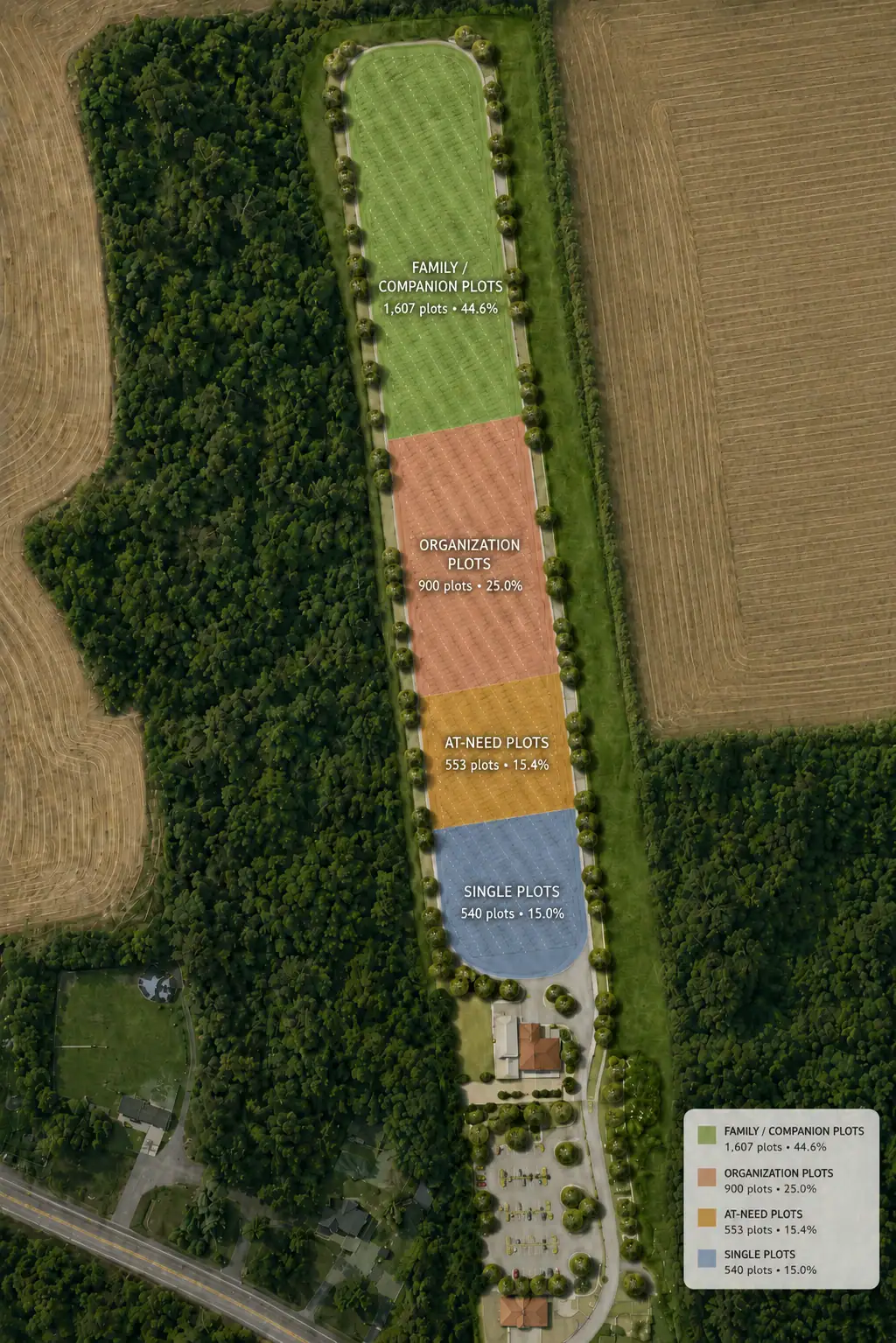
When memorial grounds are Qibla-oriented by design, the orientation isn’t something that gets calculated on the day of burial. It’s baked into the physical layout of the grounds from the beginning: every row, every plot, and every grave lane is pre-aligned toward Mecca. The Qibla direction isn’t an input someone enters into a phone app while standing over an open grave. It’s the architectural principle the entire space was built around.
Consider the Islamic Cultural Center of New York on 96th Street in Manhattan. If you’ve ever noticed that the building doesn’t align with the Manhattan street grid, that’s why. It was deliberately rotated to face Mecca. The architects didn’t calculate the Qibla direction at the ribbon cutting, they built the direction into the structure itself. The result is that everyone who worships there faces Mecca correctly, every time, without anyone having to figure it out in the moment.
That same principle, applied to a burial ground, is what “Qibla-oriented by design” means at Akhirah House of Worship. Our memorial grounds are designed so that the Qibla orientation is a structural given: not a best effort, not a calculation made under duress, but a feature of the physical space that every burial benefits from automatically. For families who believe the Qibla requirement is spiritually significant, and under Islamic law, it is, this is the difference between certainty and approximation; between knowing it was done right and hoping it was.
We also operate as an integrated Islamic Center and memorial grounds, which means the full process, from Ghusl and Kafan to Janazah prayer and burial, can flow through a single Islamically-governed institution. Families across Queens, Brooklyn, the Bronx, Manhattan, and Long Island don’t have to coordinate between a secular funeral home, a separate mosque, and a non-Islamic cemetery while they’re grieving. The entire process is held together under one roof, guided by the same religious commitments from beginning to end.
Want live answers?
Connect with a Akhirah expert for fast, friendly support.
New York City is home to an estimated 650,000 to 1,000,000 Muslims, the largest Muslim population in North America. There are approximately 275 mosques across the five boroughs. The Bangladeshi community in New York has nearly tripled over the last decade to more than 100,000 people. The Pakistani community exceeds 120,000. Queens alone is roughly 6% Muslim. Brooklyn is approximately 4% Muslim. By any measure, this is one of the most significant Muslim communities in the world.
And yet the infrastructure for Islamic burial has not kept pace. Cemetery space in New York City is genuinely scarce, some of the most limited in the country. Many existing cemeteries require concrete burial vaults, which conflicts with the Islamic principle of returning the body directly to the earth. Finding a burial site that has available plots, allows earth burial without a vault, and can guarantee Qibla orientation is harder than it should be for a community this size.

One question we hear often: does New York State require embalming? The short answer is no. Embalming is not required by New York State law for standard in-state burial. It may be required for certain types of international transport, but for local burial in Queens, Brooklyn, the Bronx, Manhattan, or Long Island, families have the right to decline it. Islamic law generally discourages embalming because it involves an alteration of the body, and you should not feel pressured into it by a hospital, morgue, or funeral home that doesn’t know your religious requirements.
Another common question: can a Muslim be buried in a non-Islamic cemetery in New York? Technically, yes, but with significant caveats. Many non-Islamic cemeteries across Long Island, Queens, Brooklyn, the Bronx, and Manhattan require concrete vaults, which is contrary to Islamic practice. Others may not have sections where Qibla orientation is possible given the existing layout of the grounds. Families often discover these conflicts only after they’ve already started the process, which is exactly the kind of stress no one needs in the first 24 hours after a loss.
For Long Island families specifically, the situation is particularly acute. The Islamic Center of Long Island in Westbury and the Islamic Center of Melville both provide funeral coordination resources, but they work through partner funeral homes, not through dedicated Islamic memorial grounds. Long Island’s Muslim community has been navigating a patchwork system for years, coordinating between community organizations and conventional funeral homes that do their best but weren’t built for this purpose. Having access to a dedicated Islamic memorial grounds that serves Long Island, Queens, Brooklyn, the Bronx, and Manhattan changes that equation meaningfully.
Islamic law requires burial as soon as possible after death, ideally within 24 hours. In a city as bureaucratically layered as New York, that timeline collides hard with the reality of death certificates, burial permits, and the logistics of coordinating multiple parties under time pressure. Families who haven’t pre-planned often find themselves making permanent decisions in impossible moments, without the time or mental clarity to verify no matter if the provider they’ve found can meet the religious requirements they care about.
Pre-planning at an Islamic memorial grounds means the Qibla-oriented plot is already secured. It means your family’s wishes are documented. It means that when the moment comes, and it always comes, the people left behind can focus on grief, prayer, and community rather than logistics. The 24-hour burial mandate of Islam is a mercy in many ways, an encouragement to return the deceased to the earth quickly and begin the process of mourning properly. But it only feels like a mercy if the practical arrangements are already in place.
There’s also a generational dimension to this that we see often. Second-generation American Muslims, meaning families who grew up in Queens, in Flatbush, in Jamaica, and in neighborhoods across Long Island, sometimes find themselves making burial decisions for parents who never talked about it. Parents who came from Bangladesh, Pakistan, Yemen, or West African nations and assumed they’d eventually be buried back home. When that moment arrives and your family is trying to decide between repatriation and burial in New York, having access to a genuinely Islamic memorial grounds, one where the burial will be done correctly, where the grounds face Mecca, and where the process is guided by Islamic practice from start to finish, makes burial in New York a spiritually complete choice, not a compromise.
The name Akhirah is not incidental. In Islamic theology, the Akhirah is the afterlife, the destination every Muslim is ultimately being prepared for. Every element of Islamic burial, from the Ghusl to the Kafan to the Janazah prayer to the orientation of the grave, is an act of preparation for what comes next. That’s the mission we built Akhirah House of Worship around.
If there’s one thing worth taking away from all of this, it’s that “facing the Qibla” is not a checkbox. It’s a religious requirement with permanent consequences, and the difference between a provider who attempts it and one whose grounds are built around it is a difference that matters.
New York’s Muslim community, across Queens, Brooklyn, the Bronx, Manhattan, and Long Island, deserves burial infrastructure that matches the size and seriousness of the community. Not a patchwork of workarounds, but a purpose-built Islamic memorial grounds where every burial is Qibla-correct by design, where the full process is guided by Islamic practice, and where families don’t have to hope it was done right.
If you’re thinking about this for a loved one you’ve just lost, or if you want to plan ahead so your family doesn’t have to figure this out under pressure, Akhirah House of Worship is here to help you understand your options and make arrangements that honor what you believe.
Summary: